Applicator motion
The course of a pass, tool position and orientation, and smooth transitions between tasks.


SI_Path focuses on learning motion and spray control from surface geometry, robot state and coating requirements. Development centres on NVIDIA Isaac Lab and adapting NVIDIA Isaac GR00T models using verified painting demonstrations.
Each recorded execution connects the model's actions with robot motion and the predicted coating. This lets us examine how a strategy behaves, replay its decisions and compare model versions.
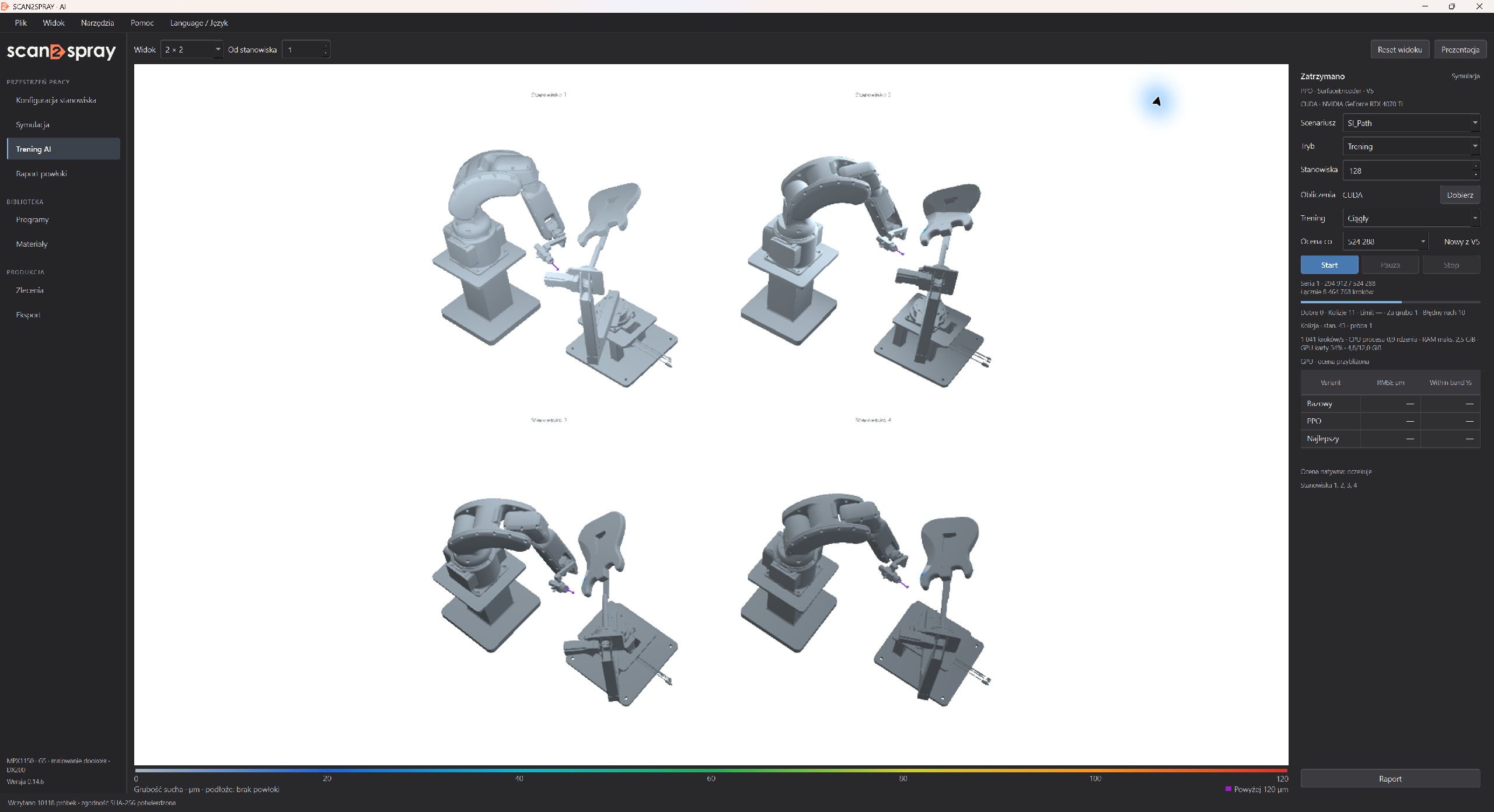

The model's task is to select an action for the situation: surface shape, tool pose, motion constraints and expected coverage. The simulation environment links these decisions to time, motion and material deposition.
The course of a pass, tool position and orientation, and smooth transitions between tasks.
Connecting valve operation and motion to the location where the coating is to be deposited.
Assessing thickness, coverage and compliance with requirements for the selected part area.
The learning workflow starts with verified, complete painting programs. Demonstrations for model adaptation require synchronised camera images, robot states and issued motion and spray commands.
The focus is adapting NVIDIA Isaac GR00T to painting tasks and evaluating its behaviour in Isaac Lab. The criteria cover motion execution, spray timing and the coating calculated from the executed motion.
Model decisions, robot states and coating evolution are recorded together. Replay makes it possible to inspect a saved execution and locate the decisions behind its outcome.
Recorded trajectories undergo additional motion and collision checks, with coating thickness recalculated using the SCAN2SPRAY simulation engine. Model evaluation and demonstration replay are assessed separately.
AI needs information about the consequences of its decisions. In SCAN2SPRAY, applicator motion is linked to the spray model, exposure time and coating build-up on the surface. Evaluation therefore addresses both the process outcome and how the task is executed.
Model comparison also covers axis limits, motion continuity, collisions and agreement between the spray signal and the program. Calculation results are related to the robot, applicator and material configuration.
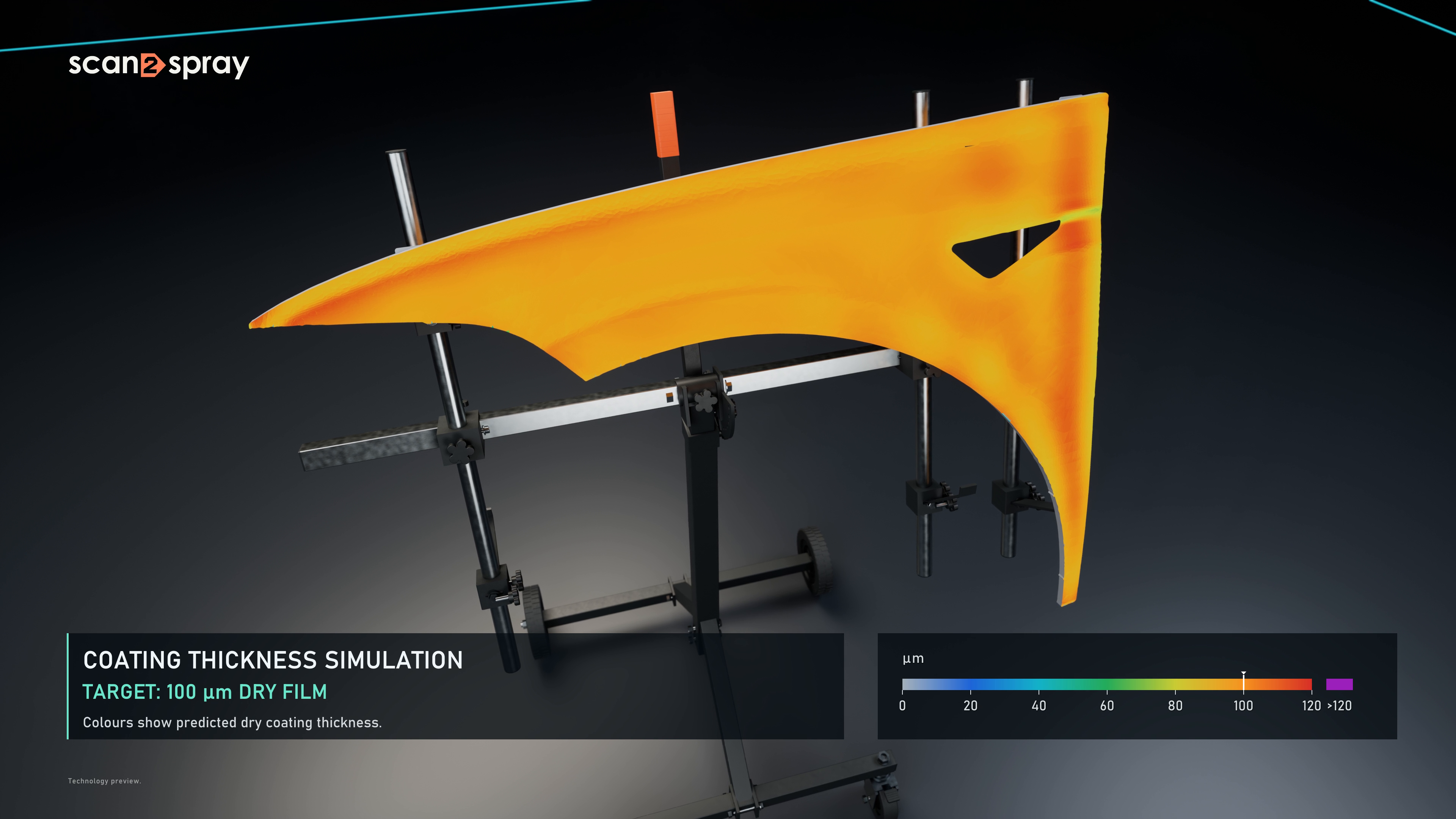
NVIDIA Isaac Lab is the selected framework for the robot simulation and learning environment. The integration work connects robot motion and process signals with SCAN2SPRAY's material deposition and film thickness calculations. PyTorch and GPU computing support the model-training workflow.
Python, NumPy and SciPy support data preparation and numerical geometry. Input data, models, simulation settings and recorded executions are linked to a specific experiment, so model versions can be compared on a consistent basis.
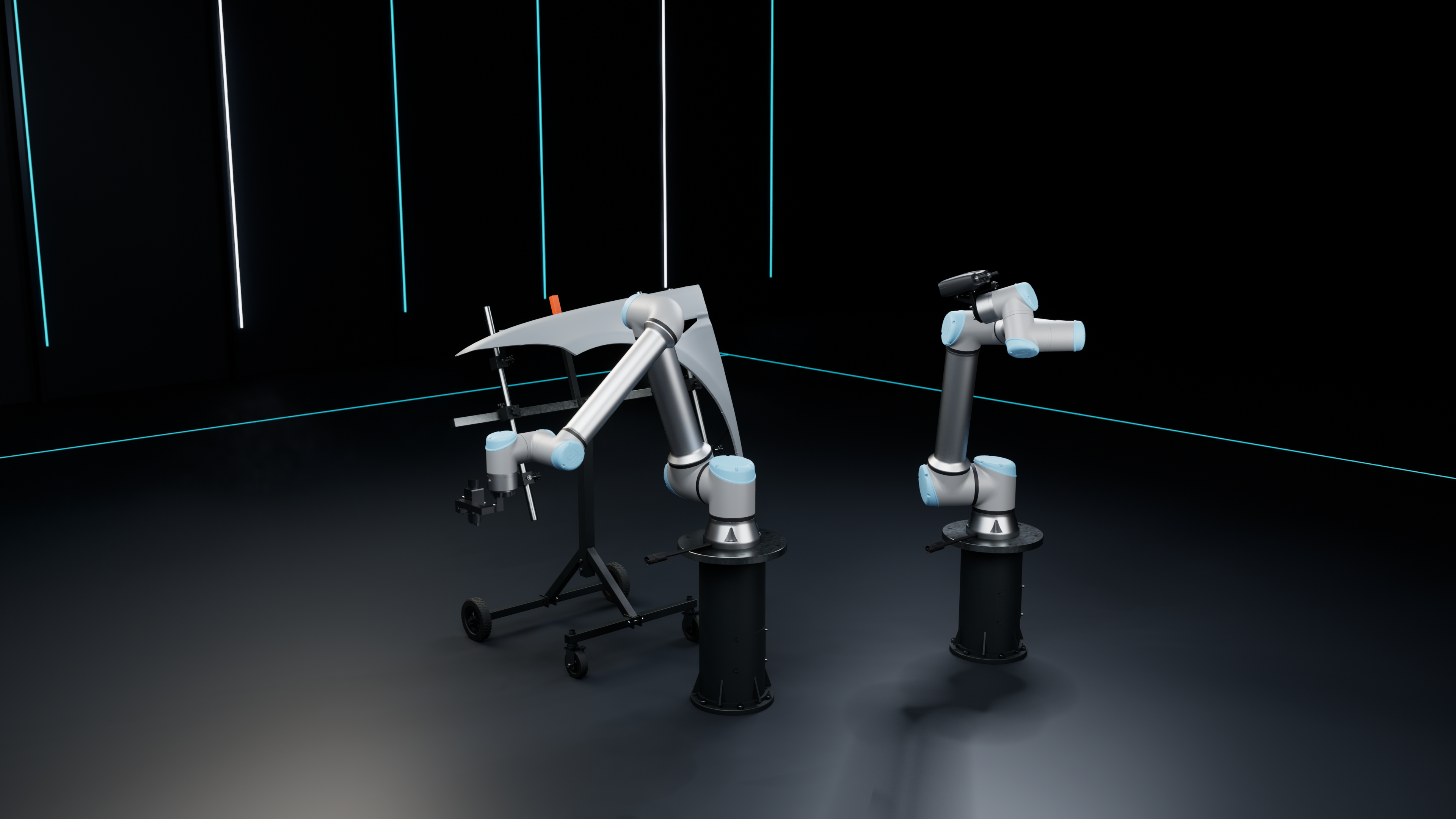
Our aim is to connect geometry understanding, strategy learning and cell integration in a coherent process for autonomous painting. The agenda covers six related areas.
Real-time reconstruction of CAD surfaces from scans, matching models from a library and locating the part. Evaluation: geometric accuracy, surface completeness, localisation accuracy and processing time.
Preparing painting tasks in NVIDIA Isaac Lab and adapting NVIDIA Isaac GR00T using complete painting demonstrations. Evaluation: task execution, motion continuity, spray timing and compliance with robot constraints.
Connecting the spray model with applicator data, material properties and sample measurements. Evaluation: thickness prediction error and the proportion of surface within tolerance.
Comparing models across geometry families and separate evaluation scenarios. Evaluation: behaviour outside the training set and the extent of skill transfer.
Connecting the plan to motion execution, process signals and cell automation. Evaluation: agreement between the program, motion and spray timing.
Developing applications with manufacturers of robots, applicators, paints and painting lines. Evaluation: criteria agreed for a specific part and process.
We seek collaboration around specific parts, materials and robotic configurations. Joint projects can cover calibration data, training scenarios, model evaluation and process integration with a partner's equipment.
Tell us what parts you paint, what equipment you use and what result you want to achieve. We will define the scope of a technology demonstration, joint testing or integration.
contact@prismatec.app